
GreenBusinessOwner.com’s green glossary is an ever-growing list of constantly updated key sustainable business terms for sustainability professionals (so don’t mind the date and time stamp above).
If you feel that we’re missing something, we appreciate you letting us know by adding it as a comment at the bottom.
A | B | C | D | E | F | G | H | I | J | K | L | M | N | O | P-Q | R | S | T | U-V-W-X-Y-Z
Ken Salazar – Secretary of the Interior under President Barack Obama. Salazar is in charge of the Department of the Interior, which oversees public land in the United States. Under sustainability-minded Presidents like Obama, the Interior department can generally be expected to be a good steward of public land. Under Presidents who receive large campaign contributions from the oil industry, the Interior Department can generally be expected to do heinous things like opening up public lands for auction to suburban sprawl developers or for oil and gas exploration.
kilowatt – a measure of electricity equivalent to 1,000 watts.
kilowatt hours – a measure of electricity used over time. Your electricity bill may show you how many kilowatt hours you used during the previous month, and calculate your rate accordingly.
Kindle – made by Amazon, the Kindle is a handheld device that allows people to buy and read books without actually having to have the book. The tremendous savings of energy and paper coming from not having to print and distribute books can be viewed as a huge win for the environment, though many authors and readers lament the loss of the paper book’s look and feel.
Hydroelectricity – energy that is produced by turbines being turned with water that is passing through a them. Most commonly, hydroelectricity is produced by large dams that back rivers up and create artificial reservoirs, so that a municipality can use the water when electricity is needed. Hydroelectricity is not without its environmental challenges, however, as large lakes can destroy a lot of habitat and actually act as a large producer of methane, a potent greenhouse gas.
Hydrofluorocarbons – HFC’s are used in mainly in the semiconductor industry as a solvent or cleaner. They are potent greenhouse gases when released, with estimates by climate scientists that they may be thousands of times more capable of trapping heat than an equivalent amount of carbon dioxide.
Have a suggestion for a term, organization or concept to add to our glossary? Send it along! Email info at greenbusinessowner.com with the subject line “glossary”. Thanks for helping us make this a great community resource!


Scott Cooney
Scott Cooney (twitter: scottcooney) is an adjunct professor of Sustainability in the MBA program at the University of Hawai'i, green business startup coach, author of Build a Green Small Business: Profitable Ways to Become an Ecopreneur (McGraw-Hill), and developer of the sustainability board game GBO Hawai'i. Scott has started, grown and sold two mission-driven businesses, failed miserably at a third, and is currently in his fourth. Scott's current company has three divisions: a sustainability blog network that includes the world's biggest clean energy website and reached over 5 million readers in December 2013 alone; Pono Home, a turnkey and franchiseable green home consulting service that won entrance into the clean tech incubator known as Energy Excelerator; and Cost of Solar, a solar lead generation service to connect interested homeowners and solar contractors. In his spare time, Scott surfs, plays ultimate frisbee and enjoys a good, long bike ride. Find Scott on Google Plus

Get your signed copy of
Build a Green Small Business (McGraw-Hill)!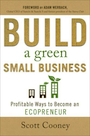
Or...talk with the author!
Click here to schedule an hour consultation.
 Green franchise opportunities:
Other green business ideas
Green franchise opportunities:
Other green business ideas
- Healthy Fast Food
- Farmer's Market
- Personal Trainer & Diet Planner
- Juice Bar and Smoothie Café
- Green Building Materials Store
- Permaculture and Urban Farming
- Edible and Organic Floristry
- Energy Efficiency Auditing
- Ecotourism and Sustainable Travel Planner
- Sustainable Coffee House
- Consignment Shop for Kids Clothing & Toys
- Natural Foods Co-op
- Sustainable Food Prep and Cooking Instruction
- Food Plant Nursery
- Mesh Network Telephone and Internet Company
- Drive-thru Coffee Stand & Espresso Shop
- Eco-Friendly House Cleaning Service
- Organic Backyard Garden Landscape Design
- Green Bed and Breakfast (B&B)
- Sustainable Mobile Food Vendor
- Biodiesel Cooperative
- Eco Friendly Pool and Spa Cleaning
- Green Wedding and Sustainable Event Planner
- Organic Farm
- Gift Basket Service
- Pedicab Company
- Used Books Vending Machines
- Organic Day Spa
- Restaurant Food Delivery Service
- Used Bicycle Retailer
- Landscape Maintenance in Arid climates
- Organic Food Delivery Service
- Outdoor Gear Consignment Shop
- Eco Concierge Service and Relocation Specialist
- Organic Community Supported Agriculture
- Sustainable Property Management
- Residential Solar

